Logo

Program Objectives, Outcomes and Matrix

Program Objectives

Program Objectives

  1. Mastery of the basic sources and concepts, procedures and principles of the theological disciplines,
  2. The ability to put the acquired theoretical knowledge into practice using appropriate means and methods,
  3. Possess analytical, multidimensional and critical thinking skills that enable them to solve problems in this field on a scientific basis and with an interdisciplinary approach,
  4. Mastery of the specialized language (Arabic and English) at a level that enables them to understand the basic sources and research texts of the theological field and to communicate with colleagues in other countries,
  5. To take advantage of information technologies, to take responsibility as an individual or as a team member and to share their knowledge and skills through various means of communication, to act according to the lifelong learning approach,
  6. To educate people who are committed to religious and moral principles, have internalized universal values, protect historical and cultural heritage, are sensitive to their environment and are aware of their role as role models.

Program Outcomes

1. Acquires extensive theoretical, and practical content knowledge of the field.

2. Uses the field knowledge in different working environments.

3. Recognizes and knows the professional application areas.

4. Selects, uses and develops the appropriate tools for the field of theology, and uses the information and information technologies required by the field at an advanced level.

5. Identifies and interprets classical and contemporary religious issues, and develops evidence-based solutions via using the knowledge gained from the field; for this purpose, selects and applies the appropriate analysis, synthesis and modeling methods, and evaluates the results.

6. Can carry out an advanced study in the field of theology independently, takes responsibility for the solution to the problems encountered in the field of religious services and religious education, both individually and as a team member.

7. Follows the theoretical and applied information in the field of theology via using a foreign language, and shares this information with experts and non-experts in the relevant field (European Language Portfolio B1 General Level).

8. Follows the developments in science and technology related to the field, acquires the ability to constantly renew her/himself and develops lifelong learning awareness by following innovations and developments in not only  her/his professional studies but also in social sciences and humanities.

9. Displays behaviors that will set an example for the society with his attitudes and behaviors in line with the requirements of the theological knowledge acquired; and is sensitive to religious, moral and social values.

10. Develops awareness of the effects and legal consequences of religious understanding and practices in universal and social dimensions (security, health, economy, environment, etc.).

11. Develops an open attitude towards changing situations of life and innovation; and is aware of current developments concerning the society.

12. Develops systematic, consistent, critical and creative thinking ability and capacity, evaluates the theology disciplines from an interdisciplinary perspective by considering its relationship with other disciplines.


Discipline-Specific Outcomes(Undergraduate)

1. Can read and understand basic religious texts.

2.  Has the competence to interpret the beliefs, worship, morals, customs and traditions of the society in light of the basic sources of Islam in order to enlighten the society by using appropriate tools.

3. Has the ability to read, understand and teach the Qur'an well.

4. Distinguishes the beliefs, attitudes, and behaviors between authentic knowledge and superstition that take which may take their reference from the basic sources of religion.

5. Evaluates the theological and theoretical structures and historical developments of different religious movements.

6. Has basic and holistic information about Islamic culture, art and civilization.

7. Comprehends schools, theories and issues in the field of philosophy and religious sciences, evaluates the existing knowledge in these fields with a critical approach.

8. Has the knowledge and skills to provide religious education and religious services, religious counseling and guidance based on the basic sources of religion and scientific data.

9. Has the competence to base on respect and justice in the face of different opinions and interpretations.

10. Has the ability to develop a discourse and attitude against tendencies that are harmful to religion and society. Such as abuse of religion, violence, and Islamophobia.

11. Improves his knowledge by following scientific developments in their field and other related disciplines; can conduct research by using scientific research methods and techniques related to the field.

12. Has the ability to read and understand basic Arabic sources.

13. To have the ability to recognize human beings in terms of their existence, thoughts, attitudes and behaviors and to understand them from a religious perspective.

Discipline-Specific Outcomes (English Theology Program)


1. Can read and understand basic religious texts.

2. He has the competence to interpret the beliefs, worship, morals, customs and traditions of the society in the light of the basic sources of Islam in order to enlighten the society.

3. Has the ability to read, understand and teach the Qur'an well.

4. Distinguishes the beliefs, attitudes, and behaviors between authentic knowledge and superstition that take which may take their reference from the basic sources of religion.

5. Evaluates the theological and theoretical structures and historical developments of different religious movements.

6. Has basic and holistic information about Islamic culture, art and civilization.

7. Comprehends schools, theories and issues in the field of philosophy and religious sciences, evaluates the existing knowledge in these fields with a critical approach.

8. Has the knowledge and skills to provide religious education and religious services, religious counseling, and guidance based on the basic sources of religion and scientific data.

9. Has the competence to behave with respect and justice towards different opinions and interpretations.

10. Has the ability to develop a discourse and attitude against tendencies that are harmful to religion and society. Such as abuse of religion, violence, and Islamophobia.

11. Improves his knowledge by following scientific developments in their field and other related disciplines; can conduct research by using scientific research methods and techniques related to the field.

12. Has the ability to read and understand basic sources in English.

13. To have the ability to recognize human beings in terms of their existence, thoughts, attitudes and behaviors and to understand them from a religious perspective.

PROGRAM OUTCOMES AND TYYÇ MATRIX

1 Lowest – 5 Highest

Türkiye Higher Education Qualifications

Humanities Core (22)

Education and Training Area: 221-Religion

Level 6 (Undergraduate Education)

Academically Weighted Qualifications

Istanbul University Faculty of Theology

Program Outcomes

(Program Outputs are listed below)

1

2

3

4

5

6

7

8

9

10

11

12

INFORMATION

1. Has course materials containing up-to-date information, applied tools and materials, research methods and techniques applied in field studies, and advanced theoretical and applied knowledge supported by other sources based on the competencies gained in the field of humanities.

5

SKILLS

1. Uses advanced theoretical and applied knowledge acquired in the field of humanities.

5

2. Theoretical and applied knowledge gained in the field of humanities; uses, analyzes and applies in the fields of education, research and community service.

3

4

COMPETENCIES

Ability to Work Independently and Take Responsibility

1. Works independently as an individual or takes responsibility as a team member to solve complex and unpredictable problems encountered in the field of humanities.

5

2. He/she plans the activities for the development of the employees under his/her responsibility.

3

3. Plans personal and institutional development by using the knowledge and skills in the field of humanities.

Learning Competence

1. Evaluates the knowledge and skills acquired in the field of humanities with a critical approach.

4

2. Determines the learning needs of the employees under his/her responsibility and manages the learning processes.

3. Develops a positive attitude towards lifelong learning.

5

Communication and Social Competence

1. Informs the relevant people and institutions in the field of humanities and conveys their thoughts to them, and puts forward the theoretical and practical solutions to the problems.

3

3

Supports solution proposals for problems related to the field of humanities with quantitative and qualitative data, and shares these data with experts and institutions in the relevant field through various communication tools.

3

3

3. Participates in various social, cultural and artistic activities in the field of humanities.

3

4. Follows the theoretical and applied knowledge in the field of humanities using a foreign language and shares this information with experts and non-experts in the relevant field (European Language Portfolio B1 General Level).

5

Uses information and information technologies at an advanced level, together with computer software required by the field of humanities .

5

Domain-Specific Competence

1. Collects, analyzes, interprets and shares information about the field of humanities with relevant persons, institutions and organizations.

4

2. Observes ethical values in the process of applying information related to the field of humanities.

5

3. Supports the universality of social and cultural rights in the field of humanities, gains awareness of social justice, and protects historical and cultural heritage.

3

4. Conducts interdisciplinary research and analysis in the field of humanities.

5

5. Acts and participates in quality management and processes.


Istanbul University Faculty of Theology Program Outcomes

1. Has extensive theoretical and practical content knowledge of the field.

2. Uses his field knowledge in different working environments.

3. Knows the professional application areas knowingly.

4. Selects, uses and develops appropriate tools for the field of theology and makes effective use of information technologies.

5. Identifies and interprets classical and current religious issues and develops evidence-based solutions by using the knowledge gained from the field; for this purpose, selects and applies the appropriate analysis, synthesis and modeling methods and evaluates the results.

6. Takes individual initiative and works independently or takes responsibility as a team member.

7. Has verbal/written effective communication/oratory and expression skills in Turkish and at least one foreign language.

8. Has self-motivation, access to information, following developments in science and technology, time management, self-renewal skills and lifelong learning awareness.

9. He is sensitive to religious, moral and social values, and exhibits behavior that will set an example for the society in line with his theological education.

10. Has awareness of the effects and legal consequences of religious understanding and practices in universal and social dimensions (security, health, economy, environment, etc.).

11. Has an open attitude towards changing life and innovation; is aware of current developments concerning the society.

12. Makes interdisciplinary research, analysis, interpretation and analysis by establishing relations with theology sub-branches and other scientific fields.


Program Objectives

1. Having knowledge of the basic sources and concepts, procedures and principles of theology disciplines,

2. Able to transfer the theoretical knowledge acquired into practice with appropriate tools and methods,

3. Have analytical, versatile and critical thinking skills that will enable them to deal with the problems related to the field on a scientific basis and with an interdisciplinary approach,

4. Having professional language (Arabic and English) proficiency at a level to be able to understand the main source and research texts of the theology field and to communicate with colleagues in other countries,

5. Benefiting from information technologies, taking responsibility individually or as a team member, sharing their knowledge and skills through various means of communication, acting with a lifelong learning approach,

Educating individuals who adhere to religious and moral principles, internalize universal values, protect their historical and cultural heritage, are sensitive to their environment, and are conscious of being role models.

p.p1 {margin: 0.0px 0.0px 0.0px 0.0px; font: 10.5px Helvetica; color: #555555}
p.p2 {margin: 0.0px 0.0px 0.0px 0.0px; font: 12.0px Helvetica}
p.p3 {margin: 0.0px 0.0px 0.0px 0.0px; font: 10.5px Helvetica; color: #595959}
span.s1 {font: 10.5px Helvetica; color: #595959}

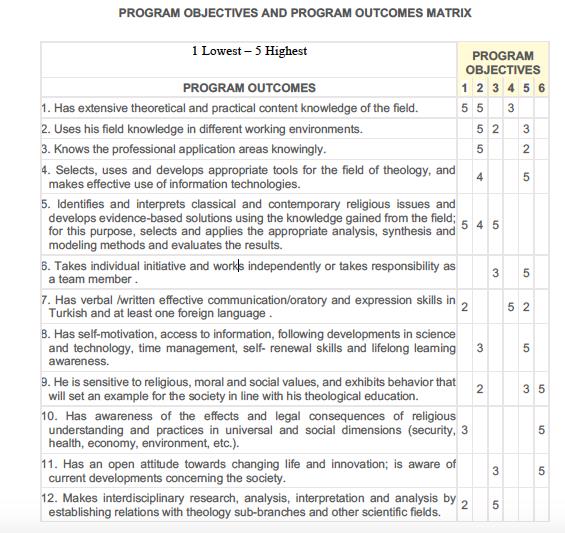
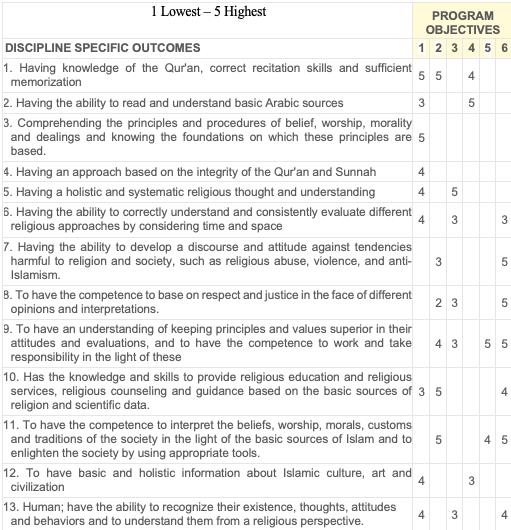
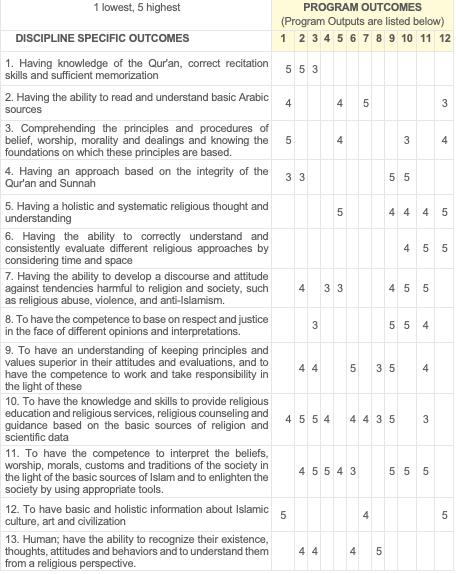
PROGRAM OBJECTIVES AND DISCIPLINE SPECIFIC OUTCOMES


Program Objectives

1. Having knowledge of the basic sources and concepts, procedures and principles of theology disciplines,

2. Able to transfer the theoretical knowledge acquired into practice with appropriate tools and methods,

3. Have analytical, versatile and critical thinking skills that will enable them to deal with the problems related to the field on a scientific basis and with an interdisciplinary approach,

4. Having professional language (Arabic and English) proficiency at a level to be able to understand the main source and research texts of the theology field and to communicate with colleagues in other countries,

5. Benefiting from information technologies, taking responsibility individually or as a team member, sharing their knowledge and skills through various means of communication, acting with a lifelong learning approach,

6. Educating individuals who adhere to religious and moral principles, internalize universal values, protect their historical and cultural heritage, are sensitive to their environment, and are conscious of being role models.


PROGRAM OUTPUTS AND DISCIPLINE SPECIFIC OUTCOMES


Istanbul University Faculty of Theology Program Outcomes

1. Has extensive theoretical and practical content knowledge of the field.

2. Uses his field knowledge in different working environments.

3. Knows the professional application areas knowingly.

4. Selects, uses and develops appropriate tools for the field of theology and makes effective use of information technologies.

5. Identifies and interprets classical and contemporary religious issues and develops evidence-based solutions using the knowledge gained from the field; for this purpose, selects and applies the appropriate analysis, synthesis and modeling methods and evaluates the results.

6. Takes individual initiative and works independently or takes responsibility as a team member.

7. Has verbal/written effective communication/oratory and expression skills in Turkish and at least one foreign language.

8. Has self-motivation, access to information, following developments in science and technology, time management, self-renewal skills and lifelong learning awareness.

9. He is sensitive to religious, moral and social values, and exhibits behavior that will set an example for the society in line with his theological education.

10. Has awareness of the effects and legal consequences of religious understanding and practices in universal and social dimensions (security, health, economy, environment, etc.).

11. Has an open attitude towards changing life and innovation; is aware of current developments concerning the society.

12. Makes interdisciplinary research, analysis, interpretation and analysis by establishing relations with theology sub-branches and other scientific fields.


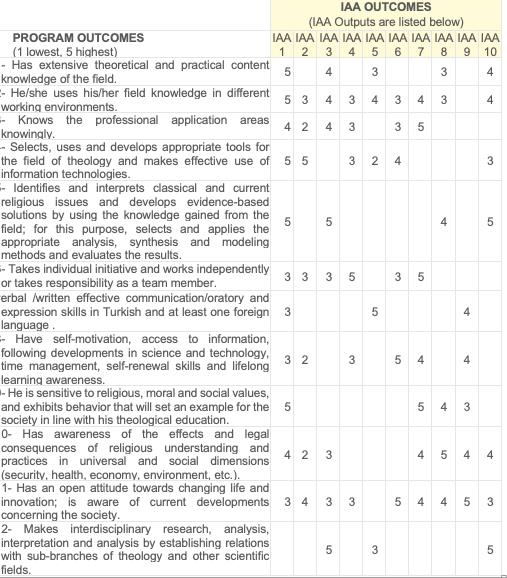
PROGRAM OUTPUTS AND IAA OUTPUTS MATRIX


IAA Outputs

1. Comprehends the basic concepts in the field of theology and has a command of the relations between concepts. Theoretical and applied knowledge gained in the field; uses in the fields of education, research and community service.

2. Selects, uses and develops appropriate tools for the field of theology and makes effective use of information technologies.

3. Has the ability to identify, define, interpret, formulate and solve classical and contemporary religious issues; for this purpose, it selects the appropriate analysis, synthesis and modeling methods and evaluates its reflections in practice.

4. Takes individual initiative and works independently or takes responsibility as a team member. Plans activities for the personal and professional development of those under his/her responsibility.

5. Have effective verbal/written communication/oratory and expression skills in Turkish and at least one foreign language.

6. Has self-motivation, access to information, following developments in science and technology, time management, self-renewal skills and lifelong learning awareness.

7. Acts in line with the requirements of the theological knowledge he has acquired, and sets an example for the society with his attitudes and behaviors. It uses its expert knowledge in accordance with scientific and moral values with the awareness of social responsibility.

8. Has awareness of the effects and legal consequences of religious understanding and practices in universal and social dimensions (security, health, economy, environment, etc.).

9. Has an open attitude towards changing life and innovation. He is aware of scientific, social, economic, legal and political developments.

10. Makes interdisciplinary research, analysis, interpretation and analysis by establishing relations with sub-branches of theology and other fields of science.

( See : https://iaa.org.tr/wp-content/uploads/2020/10/iaa_lisans_olcutler.pdf )


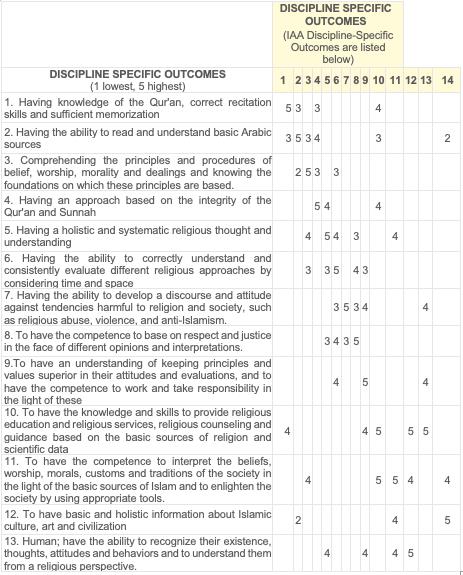
DISCIPLINE-SPECIAL OUTCOMES AND IAA DISCIPLINE-SPECIAL OUTCOMES MATRIX


IAA Discipline-Specific Outputs

1. Having knowledge of the Qur'an, correct recitation skills and sufficient memorization

2. Having the ability to read and understand basic Arabic sources

3. Comprehending the principles and procedures of belief, worship, morality and dealings and knowing the foundations on which these principles are based.

4. Having an approach based on the integrity of the Qur'an and Sunnah

5. Having a holistic and systematic religious thought and understanding

6. Having the ability to correctly understand and consistently evaluate different religious approaches that emerge according to time and place

7. Having the ability to develop a discourse and attitude against tendencies harmful to religion and society, such as religious abuse, violence, and anti-Islamism.

8. To have the competence to base on respect and justice in the face of different opinions and interpretations.

9. Having an understanding that prioritizes principles and values over individuals and institutions

10. Having the competence to provide religious education and religious services based on the basic sources of religion and scientific data

11. To have the competence to interpret the beliefs, worship, morals, customs and traditions of the society in the light of the basic sources of Islam and to enlighten the society

12. To have knowledge and skills of religious counseling and guidance

13. Having the competence to work and take responsibility in the light of basic values/principles such as reason, knowledge, consultation, respect for trust, competence and justice

14. To have basic and holistic information about Islamic culture, art and civilization

(See: https://iaa.org.tr/wp-content/uploads/2020/10/iaa_lisans_olcutler.pdf)


Syllabuses and Matrices

Click here for the fall semester syllabuses and matrices.

Click here for the spring semester syllabuses and matrices.